A Man I'll Never Be: A Software Engineering Identity Crisis

The first LPs (that's "long-playing record" to you children in the audience) that I ever bought with my own money were two used ones: "A Farewell To Kings," by Rush, and Boston's self-titled debut album. I was a big Boston fan. The first time I ever heard Boston was in our high school band hall. Our band director had these massive PA speakers he'd sometimes play rock music through, usually either Boston or Steely Dan. The high volume and super-wide stereo separation was perfect for the dramatic sounds of those first two Boston records. If you listened to FM rock radio in that era, the 80s, it was clear that Boston had defined a very particular sound that everyone else imitated.
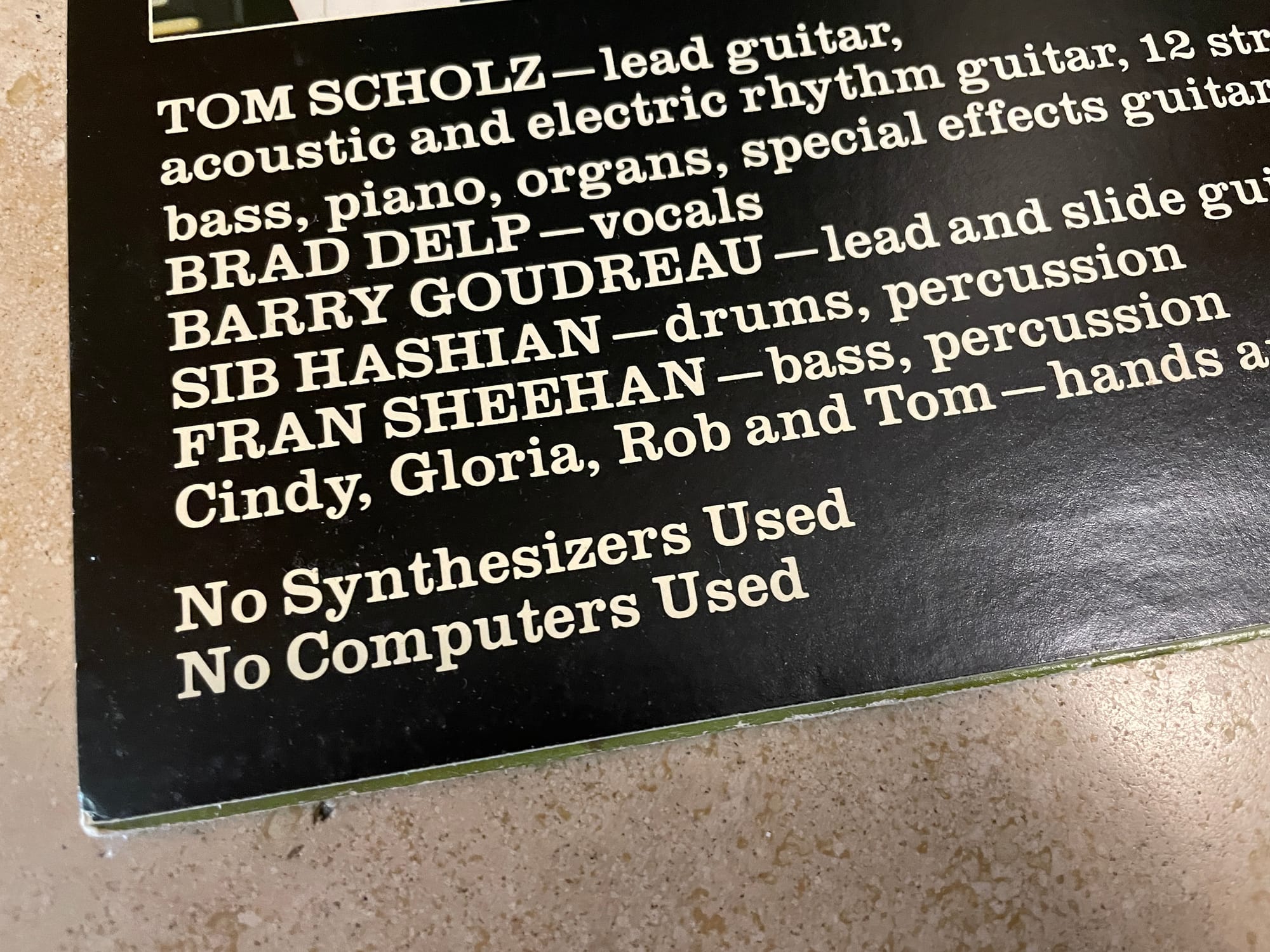
Eventually I bought the second Boston album, Don't Look Back, on vinyl. One of the awesome things about LPs was the large size of the album, which allowed lots of artwork and info about the recording on the back. Their second record had a prominent message on the back: "No Synthesizers Used. No Computers Used." Like some kind of badge of honor. The record was released in 1978, but I bought it in the 80s, and by then synths were pretty ubiquitous, so it seemed like a weird affectation. But it was hard to argue with the quality of the music on the record.
Why would he make such a big deal about synths? I didn't know at the time, but Scholz, who basically was Boston, had a degree in engineering from MIT, and had built all his guitar gear himself, to create that very specific Boston sound. You can understand the disdain at taking the easy way out: just using synths and computers to create the cool sounds, when he could meticulously craft them himself, with his own amazing skills. It's a great record, and still stands up today, and in '78, being the synth refusenik likely seemed a principled stand against encroaching decadence, maintaining full artistic control. Sound familiar? If you are connected to the current zeitgeist of software development, you are seeing a similar sentiment from a subset of engineers who steadfastly refuse to use AI tools for coding.
This will seem like insanity or quaint wrong-headedness in a year or so, but they're out there now: "AI code is slop." "I can write code better." "I will never, ever use that." Coding, being a programmer, is who they are. They don't want to become management. And the arguments they give, are ones we've already seen. In the late 60s, with the introduction of high-level languages like FORTRAN, COBOL, and ALGOL, coders who were accustomed to meticulously hand-crafting their assembly-language code, objected to them on the basis of bloated code, memory hogging, slow execution speed, and of course, the ever-popular "lack of control." Sound familiar? Back then common wisdom was that Real Programmers Don't Use Pascal.
There have been multiple waves of this, from assembly to those higher-level languages, later including C, to memory-managed and GC languages like Java, which was initially slow and incredibly bloated. From Java to scripting languages like Ruby, Python, and JavaScript. I can certainly remember at various points in my career the Very Serious Java Programmers looking down their nose at anyone building backend services with Node, which seems pretty hilarious today.
That's not to say that this AI wave is exactly the same as these other innovations, although it is the same in general effect. The link between human intentions ("I want my code to do this.") and the actualized output, is more and more tenuous. The ratio of input to output keeps shrinking, and the input itself gets less and less specific. What makes AI agentic coding different from these previous revolutions is the degree of this effect, the sheer scale of it. You might even consider it the 'final form' of this constant innovation and refinement. We're not even writing code that writes code anymore. We're writing ordinary, plain old English, and that results in the code, and the behaviors of the software. It's a crazy world we're living in now.
There's an instructive folktale, the story of John Henry. John Henry was a Black railroad worker who drove steel spikes into rock to bore tunnels for the railroad. A new steam-powered rock drill was brought in, a machine that threatened to replace the human steel-drivers. Henry challenged the operators of the machine to a race: man vs. steam drill, driving steel into rock. It's a dramatic tale of man vs. machine, and in the end, Henry triumphs, and actually out-works the machine. But his heart then gives out, and the cost of victory is his own life. You're not likely to die trying to out-code the LLMs, but you will be out-competed by those who use them. You may not lose your life, but you will almost certainly lose your job.
I get it, you love coding and you hate the slop. Agents are dumb, they're unreliable, they screw up in weird ways, they make shit up. Tom Scholz had similar thoughts, about computers in general:
"I detest computers. If you had a device like that 30 years ago that froze up constantly, misbehaved constantly, lost your information and screwed up when you needed it the most, it would have been laughable."
This is the sound of cope; the same sound I hear from developers clinging to their artisanal, hand-coded applications today.
And yet, even with this visceral hatred of all things digital, the great nay-sayer Scholz eventually ended up letting go of his supposedly principled stand against synths, MIDI, and anything remotely computerized in music. He clung to this position for another album, Third Stage, which came out in 1986. (The big hit from that album being a song called "Amanda," which was the name of my beautiful-but-insane girlfriend at the time). The liner notes still proudly stated that "the Boston sound is powered by old, straight ahead rock-n-roll equipment, as opposed to midi-interconnected-computer-sequenced synthesizers." Cool story, Tom.
He eventually capitulated, using more and more digital processing, and eventually real synths, in later albums, acknowledging his change in approach with a tongue-in-cheek "nobody's perfect" admission in album liner notes. I remember seeing this phrase in the notes for "Walk On," when I was living in Japan in the mid-90s. My girlfriend at the time (Japanese girl, also very beautiful, but not at all crazy) had the CD, and I can remember sitting at the bar with her, taking a look at it, and thinking to myself. "Took him long enough."
In retrospect, Scholz's dogged anti-synths position looks quaint, a charming affectation. And it's undeniable that he was able to create some amazing sounds, and in fact, an industry-defining sound for rock music that persisted for more than a decade; an enviable achievement. I'd even argue that the very first Boston album is the best, with each of their releases becoming monotonically worse. The ones without the synths are unambiguously the best albums. But the appearance of synths on the later, worse albums are correlation, not causation. The decay in quality of the later Boston releases has much more obvious causes: the laziness and complacency brought by success, over-reliance on his own technical systems (specifically the Rockman, which has a characteristically brittle sound), and the departure of Brad Delp, whose vocals were such an integral part of their overall sound.
We'll never know what the Boston sound would have been, if Scholz had embraced synth earlier. The late 70's had some great synth sounds, and contemporaries like Pink Floyd embraced them fully and created pioneering music. And as synths and digital signal processing took over the music world, what started as a principled purism began to look more and more foolish and out of touch with reality. As AI and agentic systems continue to take over modern technology, the current foot-dragging of the anti-AI coders will rapidly look the same.