I love it loud, mostly


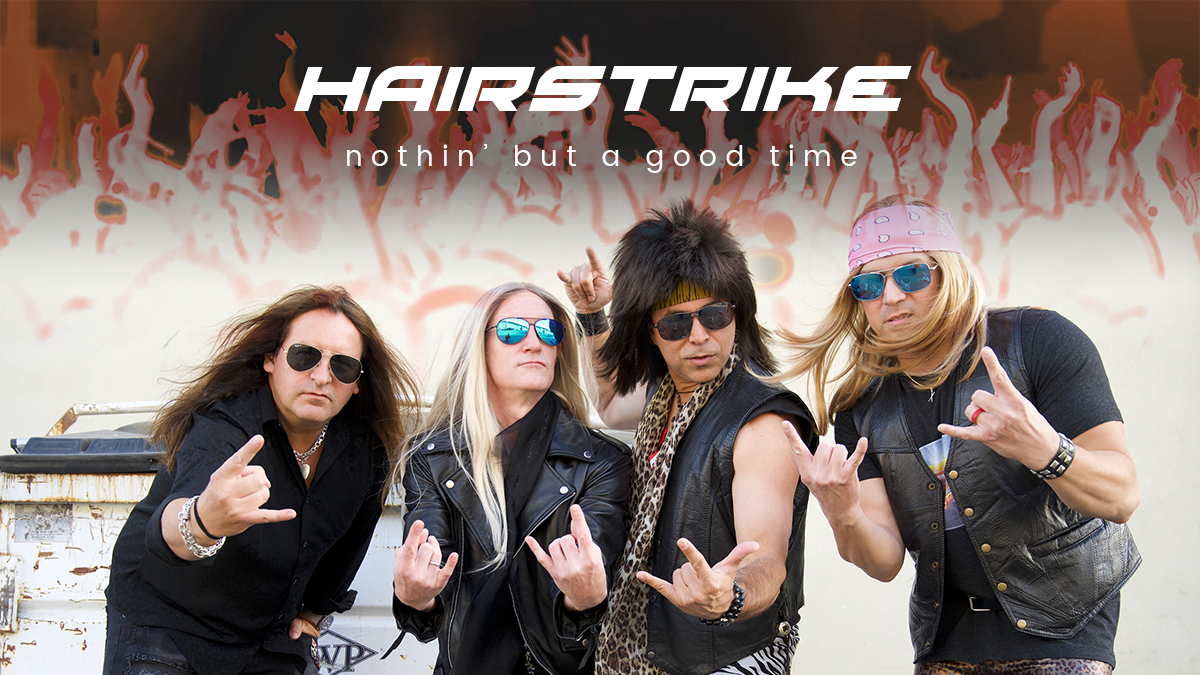
I have alway referred to myself as a "literal rock-star developer," because I sing lead and play guitar in an 80s hair-metal band called Hairstrike. Yeah, 80s butt-rock: GnR, Def Leppard, Ratt, Dokken, Whitesnake. The whole ridiculous thing. We wear costumes (see above photo) when we perform.
We had a gig about a year ago, with a stand-in sound man, who as it turned out, was an incompetent. He had the on-stage volume from the monitor speakers injuriously high. Throughout the whole show, I knew something was wrong. There was shit-tons of feedback, and he just couldn't get it under control. I knew something was bad, but I had no idea how bad it would be.
I've had very mild tinnitus since I was a kid, from all the time playing my drum set, and being on drumline. And because of that, I have alway been meticulous about wearing earplugs when exposed to loud sound. I wear them at every show we do. I was wearing them at that particular show in October of last year.
Apparently it did not matter. I woke up after that show with a loud ringing sound in my ears, which unfortunately never went away. I can hear it right now, as I sit here typing. At the time, it was about 60dB, which is about sound level of a window air-conditioning unit. That may not sound super loud, but it's a high-pitched sound, and more importantly it never goes away. It's a constant tone playing in my brain. A sound that doesn't really exist, but my brain produces because of hearing loss at those frequencies. Thanks, brain.
I'm in good company. The list of musicians suffering from this is long: Eric Clapton, Ozzy, Pete Townshend, Neil Young, Moby, Bono Vox, Dave Grohl. Even William Shatner (okay, we'll charitably call him a musician, too) has wrestled with tinnitus caused by being too close to the SFX explosion while filming an episode of the original Star Trek series. Rick Beato has a video about his tinnitus.
It was pretty bad, especially at first. I couldn't sleep more than about two hours at a time. Eventually I found a few things that helped, particularly sound therapy. There's a variety of different techniques, starting with just the obvious masking the tinnitus sound with other sounds at the same frequency (crickets are a perennial favorite).
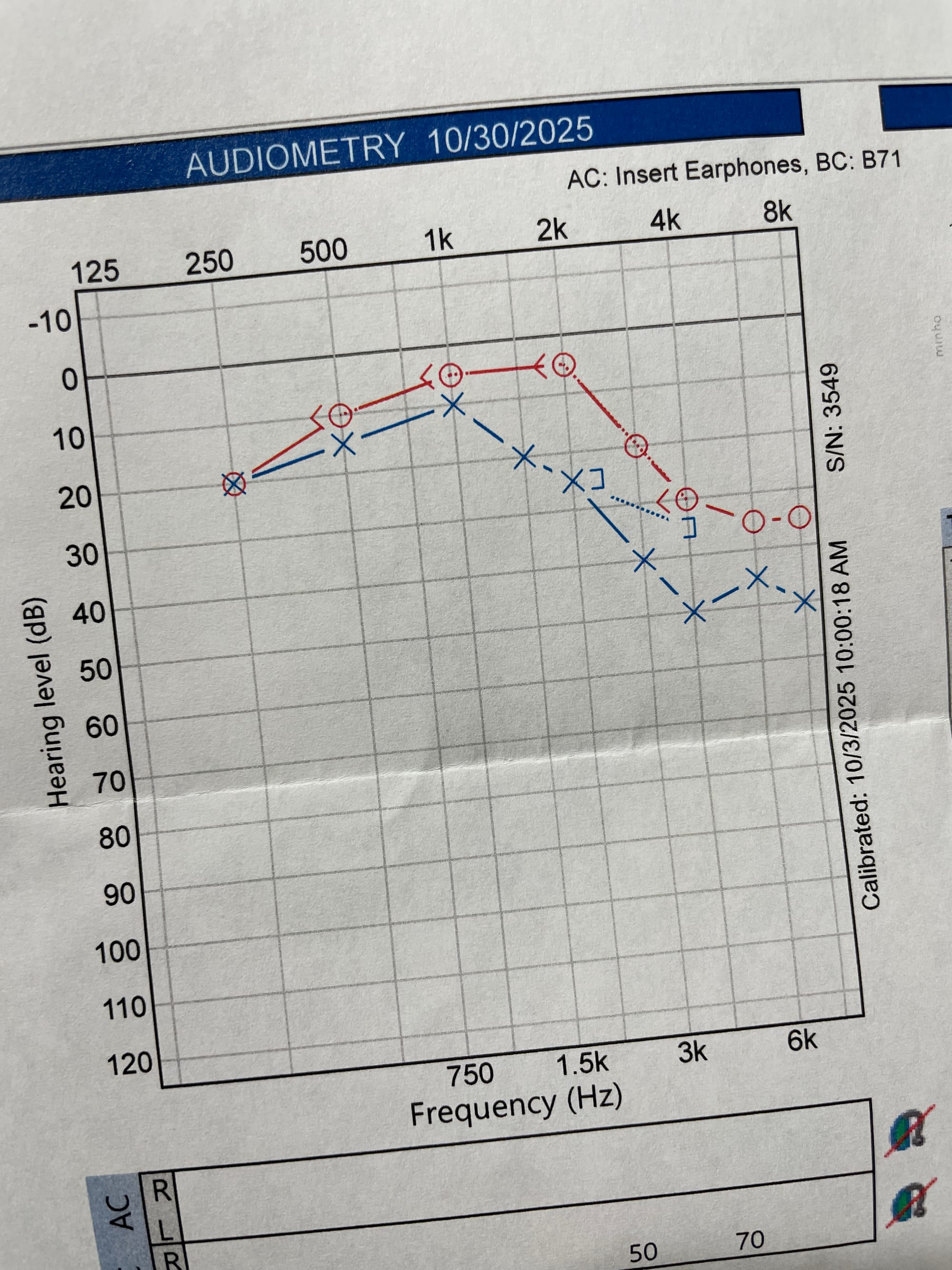
I eventually went to the doctor, had my hearing tested, with the predictable response of "sorry, there's nothing we can do for you."
After a few weeks, I was probably sleeping about three to four hours a night, and getting through my days with lots of trips to the coffee shop, for the noise, and all kinds of natural sounds: anything with high frequencies to take the edge off the constant beeeeeeeeeee sound in my ears. I was constantly looking for anything else I could try, to fix it, get rid of it, reduce it, something, anything.
I did a bunch of research online, and found some other approaches, which are based on the root cause of tinnitus: it's the audio equivalent of phantom limb syndrome. There are a bunch of neurons in your audio cortex that are used to processing these high-pitched frequencies. And when those frequencies disappear (because hearing loss), those neurons have nothing to do, so they start ad libbing, just firing on their own apropos of fucking nothing. And like little-league soccer kids swarming ball during a game, these neurons all start to converge on a common frequency. This is why tinnitus sufferers hear a particular pitch. My left ear is about 4KHz, and the right ear is about 8KHz.
These other sound-therapy approaches aim to disrupt that convergence. The first one I found, called Acoustic Coordinated Reset Neuromodulation (ACRN), plays tones in a random order nearby your tinnitus pitch, which encourages those neurons to diverge from that common frequency. It's been around for some years., and there is evidence that it works, but in the original study, people had to listen to these tones for four to six hours a day for three months for any real therapeutic effect. Holy shit, that's a lot of listening to a beep-beep-beep. I found there was a Web-page implementation of this, as well as multiple iPhone apps for it, on the App Store. So I bought one of the apps, called Tinnitus Therapy, and started.
I was about six weeks into the beeping, when I found another published paper on a related approach: Cross-Frequency De-correlating Stimulus Modulation (which is quite a mouthful, explains why they decided to call it "spectral ripple therapy"). In this study, the participants only listened for an hour a day, for six weeks, and experienced a decrease in their tinnitus volume that remained after the therapy ended. That sounded awesome. I wanted to try it. Hell, I was willing to try anything at that point.
The paper had only been out a few months, so there were no existing implementations of it. And trying to implement it myself at the time would have required using MATLAB, a commercial (and fucking expensive) academic software platform. (This is early Dec. 2025, just pre-agentic-revolution.)
I contacted the one of the authors of the study, and was shocked and filled with gratitude when he responded literally the next day, from the UK. And bless that doctor's soul, he took the time to generate two different WAV files for me, based on the tinnitus frequencies of my left and right ears.
Spectral ripple sounds basically somewhere between a fly buzzing and an electric circular saw, but in a pleasant way. After weeks of listening, subjectively it did seem to reduce the tinnitus volume a little bit. Now it's settled to about 50dB, the volume level of a loud fridge, or an electric fan. I can't say for sure that it's been reduced, and of course placebo effect is a real thing, but it seems to have helped, and interestingly, it has actually de-tuned my tinnitus, with the result sounding a bit more like white noise than a specific pitch, which is also a relief.
It took about 10 weeks for my brain to habituate to the sound. (Which, ironically it's also creating by its own self, what a dumbass brain.) I can actually sleep normally now, and most of the time I don't actually notice it, except when it's really quiet around me. It will likely never go away. It's the first thing I hear every morning when I wake up, and my first thought is always "holy shit, that's pretty loud."
Given how awful the initial experience was, and how the sound therapy seems to have helped me, I decided I'd make an iOS app that could play all three types of therapy: ACRN, spectral ripple, and nature sounds all at once, in the background on my iPhone. I've always been a Web developer but now that we've entered the age of agentic coding, I figured it couldn't be that hard. That's been an interesting process, putting it charitably. Turns out, coding the actual app wasn't the hard part.